Rolled beef zrazy. A rye crust and twenty-four zrazy
🎧 Listen (Audio)
Audio versions are read by a synthetic voice.
Listen in the Dobre Państwo podcast (Spotify) RSS
"I too took part in the independence movement. I had been invited to friends' for supper. When I arrived, it turned out that the police had just taken all the guests to the station. I had to eat twenty-four zrazy."
I remember the sound of the meat mallet, the smell of onion frying in fat and that moment when the aroma of beef, mustard, bay leaf and dried mushrooms began to rise from the pot. You were not yet sitting at the table, but you already knew that dinner would be a serious matter.
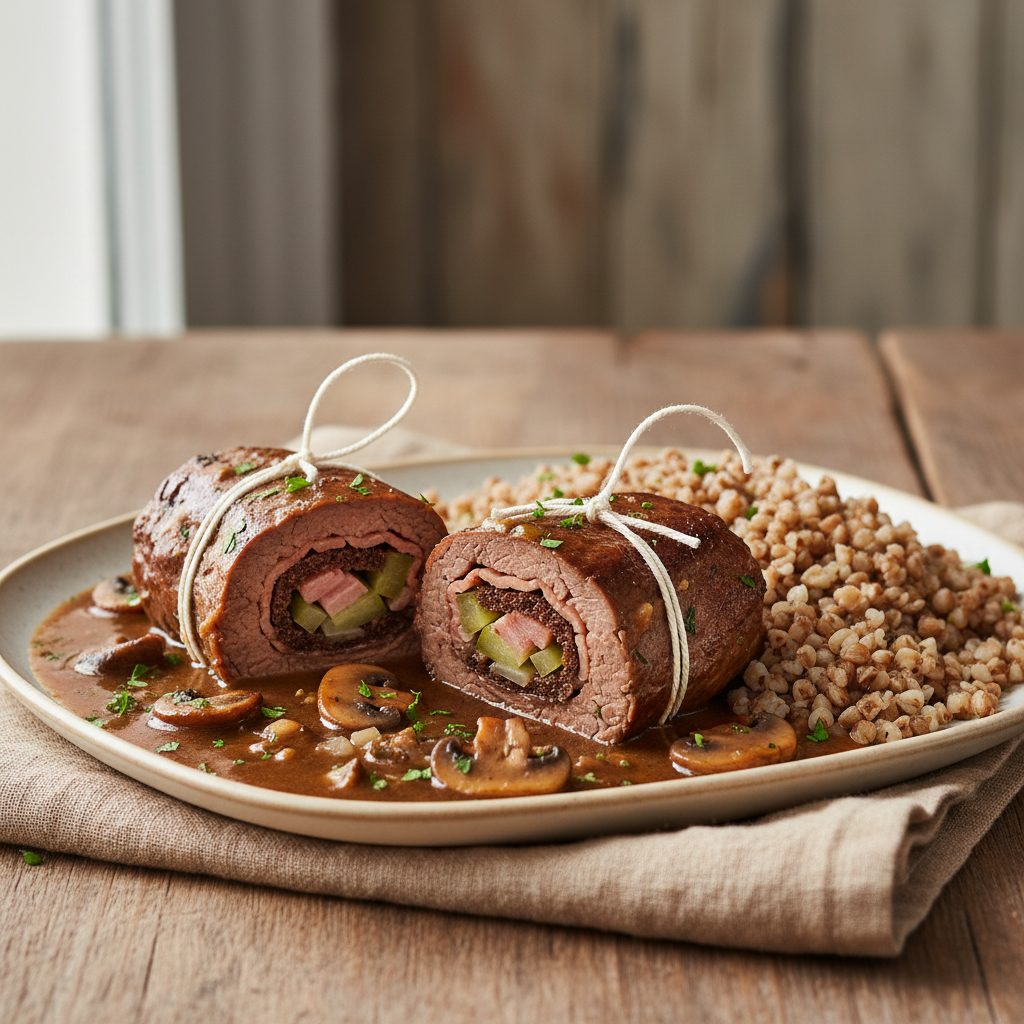
A thin slice of beef is spread with mustard, and on it go bacon, onion, pickled cucumber and a strip of stale rye-bread crust. The bread helps the roulade keep its shape, absorbs the juices, releases starch into the sauce and thickens it without a heavy roux. It brings a slightly sour, rye flavour that pairs superbly with the saltiness of the bacon and the fresh acidity of the cucumber.
Zrazy have a noble and borderland pedigree. In the old Commonwealth they were served at the tables of magnates, and over time, from a dish of the manor kitchen, they became part of everyday regional life. In Silesia you will more often hear the name rolada, best served with dumplings and red cabbage. In Greater Poland people proudly speak of zrazy zawijane po wielkopolsku, Greater Poland rolled zrazy. The name may divide, but a well-made sauce instantly reconciles the feuding parties.
A zraz needs time, because beef cannot be persuaded by shouting. First it must be seared properly, and then allowed to soften slowly in broth. After an hour and a half or two, the meat should yield under the fork and the sauce should have taken on a deep, dark flavour. Then you know the cook rushed nothing and faked nothing.
Good zrazy are hearty but not clumsy. The bacon gives them juiciness, the cucumber balance, the mustard character, and the rye bread the taste of old-fashioned thrift. In a kitchen where nothing was wasted, a stale crust could turn into a small culinary secret.
I recommend serving them without experiments that want to be cleverer than tradition. With buckwheat groats, potatoes, Silesian dumplings or a slice of good bread for mopping up the sauce. Leaving sauce on the plate is not just a culinary error. It is a lack of respect for the work and for the pot.
## A slice cut off from Lithuania
The word is Polish. "Zraz" comes from "zrazić", to cut a slice of meat off the whole. The dish itself, however, most likely came from Lithuanian cuisine and was a favourite of noble and hunting tables in the Kresy, the eastern borderlands, on the lands of today's Lithuania, Belarus and Ukraine. The first old Polish zrazy, called suropieki, were not rolled at all. They were thick slices of meat stewed in their own sauce with onion or mushrooms. The roulade with a filling is a later invention, from the end of the eighteenth century.
That was also when zrazy reached the table of King Stanisław August Poniatowski. Paul Tremo, his court cook, listed two kinds in his handbook: "zrazy from leftover roast" and "zrazy from any raw meat, even game". The first formula is a masterpiece of court diplomacy. Leftovers from a royal feast could not be called leftovers, so they became a dish in their own right. Recycling at a monarchical level. The name "zrazy zawijane", rolled zrazy, appears in culinary literature in Wojciech Wincenty Wielądko's "Kucharz doskonały", The Perfect Cook.
## A frame of stale bread
The rye crust inside a zraz is not a whim but the engineering of the housewives of old in Greater Poland and Silesia. The hard, stale crust acts as a frame. It holds the roulade's shape through the long braising and does not let it shrink. Starch from the bread slowly passes into the broth and the sauce thickens by itself, without flour or roux. Sourdough rye bread adds a slightly tangy, yeasty rye aroma that gets along with pickled cucumber and smoked bacon.
There is ethics in this too. Bread was not to be wasted, not a crumb. The stale crust, seemingly useless, became the foundation of the sauce. Thrift did not need English names to be wise.
The mustard has a job as well. Its acidity loosens the proteins in the meat and breaks down the tough fibres. Before refrigerators were invented, tough beef was wrapped in nettle leaves or buried in the ground for a few days to tenderise. Today a jar of hot mustard and a little patience will do.
## Rolada, not zraz
In Upper Silesia and Opole Silesia nobody eats zrazy. They eat rolada, in dialect roulada, and calling it a zraz can be a faux pas, if not an insult to regional identity. "U nos się godo rolady!" — around here we say rolady! Rolada with Silesian dumplings and red cabbage has the status of something sacred. It used to be a luxury dish, for Sundays, weddings and the most important celebrations, and to this day a Silesian wedding cannot take place without this set. They say the pounding of the mallet from early Sunday morning is the "Silesian alarm clock", announcing a festive dinner to the neighbours. The saying goes further: a Silesian dinner without rolada is not a dinner but an ordeal.
The authorities took part in this debate too. In December 2006 "Rolada wołowa śląska", Silesian beef roulade, was entered on the List of Traditional Products in the Silesian Voivodeship, which outraged the neighbours from the Opole region. As early as January 2007 a separate "Opolska rolada wołowa", Opole beef roulade, was added to the list and the animosities died down. A rare case of a conflict resolved by adding a second roulade.
Greater Poland has its "zrazy zawijane po wielkopolsku", entered on the same list in 2008, with a filling of fatback, chopped onion and crumbled rye bread or breadcrumbs with fat. And here another war begins. The orthodox consider smoked bacon taking the easy way out and claim that only hard fatback in strips gives the beef the right juiciness. On cooking forums there is also a cucumber war. Supporters of pickled cucumbers accuse fans of vinegar gherkins of ruining the flavour, and the latter reply that vinegar better tempers the heaviness of beef and bacon. Peace is nowhere in sight. Sauce, as we know, reconciles only for a moment.
## Pan Tadeusz and Franc Fiszer
Zrazy belong to national literature. In "Pan Tadeusz" they appear twice. Once at a noble breakfast, because in wealthy houses they were served in the morning, not just at a hearty dinner. The second time in connection with the gluttony of the tsarist officers, Major Płut and Captain Rykov, who devoured twenty-three zrazy in half an hour. The national epic knows that an occupier's appetite says the most about his character.
Franciszek Fiszer, a Warsaw erudite, philosopher and king of the pre-war cafés, was famous for his gigantic appetite and sharp tongue. In the interwar years, when many activists were inflating their merits in the struggle for freedom, he used to say that he too had taken part in the independence movement, though passively rather than actively. He came to supper, the police took the guests, and the zrazy remained. Twenty-four of them. Fiszer beat the tsarist officers by one zraz, and he did it in a just cause.
The old Polish saying "zwijać się jak zraz na patelni", to twist about like a zraz in the pan, describes someone energetic and quick to react, because the meat must be constantly turned while it sears. Today's slaughterhouses have machines for this, tenderisers that flatten the slices to an even thickness. Yet the mallet still wakes Silesia on Sundays. There are sounds no machine can replace.
## Recipe
**Ingredients:**
- 1 kg beef for zrazy (top or bottom round, or leg)
- hot mustard, preferably Sarepska or wholegrain
- smoked bacon, cut into batons or thin slices
- firm pickled cucumbers, cut lengthwise into batons
- onion in thin wedges or half-slices, preferably lightly softened
- stale bottom crust of sourdough rye bread, in strips
- freshly ground pepper, salt (sparingly)
- flour for dredging
- lard or clarified butter for frying
- broth, allspice, bay leaves, dried forest mushrooms
**Method:**
1. Pound the slices of beef very thin, preferably through cling film.
2. Spread each slice with mustard and season with pepper. Go easy on the salt, because the bacon and cucumber are salty.
3. At the edge of the meat lay the bacon, onion, cucumber and a strip of bread crust.
4. Roll up tightly into a roulade, tucking the sides in, and tie with white cotton string or secure with toothpicks.
5. Dredge the zrazy lightly in flour and sear them hard in lard on all sides.
6. Pour in the broth, add allspice, bay leaves and dried mushrooms, cover and braise slowly for about 1.5–2 hours, until the meat is tender.
7. Serve with buckwheat groats, potatoes, Silesian dumplings or bread for mopping up the sauce.
📖 Glossary
- zraz
- Nazwa od „zrazić”, czyli odciąć plaster mięsa od całości.
- suropieki
- Pierwsze staropolskie zrazy, niezawijane grube plastry mięsa duszone we własnym sosie z cebulą albo grzybami.
- rolada
- Śląska nazwa zrazu wołowego, w gwarze roulada, podawana z kluskami śląskimi i modrą kapustą.
- śląski budzik
- Stukanie tłuczka od wczesnego niedzielnego ranka, które obwieszcza sąsiadom uroczysty obiad z roladą.
Frequently Asked Questions
Why is rye bread crust added to zrazy?
The hard, stale crust acts as a frame and holds the roulade's shape through the long braising. Starch from the bread passes into the broth, so the sauce thickens by itself, without flour or roux. Sourdough rye also adds a slightly tangy aroma that goes well with the cucumber and bacon.
Where do beef zrazy come from?
The word „zraz” comes from „zrazić”, to cut off a slice of meat, but the dish itself most likely came from Lithuanian cuisine and was a favourite of tables in the Kresy. The first old Polish zrazy, suropieki, were not rolled. The filled roulade is an invention of the late eighteenth century, when zrazy reached the table of Stanisław August.
What is the difference between zrazy and Silesian rolada?
In Upper Silesia and the Opole region people eat rolada, and calling it a zraz can be a faux pas. Rolada with Silesian dumplings and red cabbage is a dish for Sundays and weddings. In 2006 „Rolada wołowa śląska” was entered on the List of Traditional Products, and in 2007 a separate „Opolska rolada wołowa” was added.
How long to braise beef zrazy?
Zrazy must first be seared hard and then braised slowly in broth for about an hour and a half to two hours. The meat should yield under the fork and the sauce should take on a deep, dark flavour.
How many zrazy did Franc Fiszer eat?
Franciszek Fiszer used to say he had taken part in the independence movement passively: he came to supper, the police took the guests, and he had to eat twenty-four zrazy. With that he beat the tsarist officers from „Pan Tadeusz”, Major Płut and Captain Rykov, who ate twenty-three zrazy in half an hour.
What to serve with rolled zrazy?
Zrazy are served without experiments, with buckwheat groats, potatoes, Silesian dumplings or a slice of good bread for mopping up the sauce. In Silesia rolada comes with dumplings and red cabbage.
Related Questions
- Why is rye bread crust added to zrazy?
- Where do beef zrazy come from?
- What is the difference between zrazy and Silesian rolada?
- How long to braise beef zrazy?
- How many zrazy did Franc Fiszer eat?
- What to serve with rolled zrazy?
🧠 Thematic Groups
- Historia: zrazy z kuchni litewskiej i kresowej, staropolskie suropieki, zrazy u Paula Tremo na stole Stanisława Augusta i nazwa „zrazy zawijane” u Wielądki.
- Technika: skórka czerstwego razowca jako stelaż i zagęstnik sosu, musztarda krusząca włókna, mocne obsmażenie i półtorej do dwóch godzin duszenia.
- Regiony i spory: śląska rolada kontra zraz, rolada śląska i opolska na Liście Produktów Tradycyjnych, zrazy po wielkopolsku, słonina kontra boczek i wojna ogórkowa.
- Literatura i anegdota: zrazy w „Panu Tadeuszu”, dwadzieścia trzy zrazy carskich oficerów i dwadzieścia cztery zrazy Franciszka Fiszera.
Tags:
rolled beef zrazy
Silesian rolada
beef
smoked bacon
pickled cucumber
rye bread
mustard
braising
Polish cuisine
Kresy
Greater Poland
Silesia
Paul Tremo
Pan Tadeusz
Franciszek Fiszer
More in: Kuchnia niepolityczna
Content is created by Fundacja Dobre Państwo.
Edited and published by APA ONE, the Foundation's own AI-based editorial system.