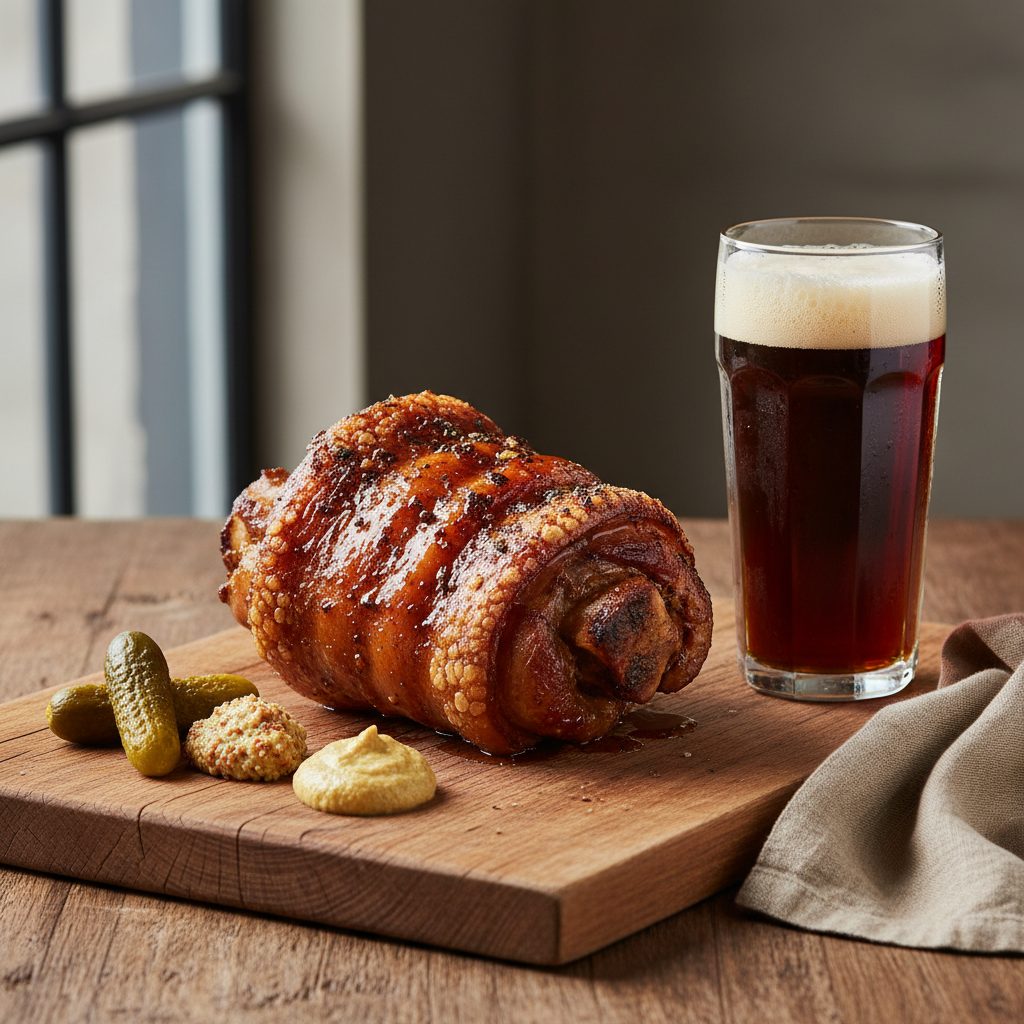
Pork knuckle roasted in beer. A thing fatty, crisp and not entirely innocent
🎧 Listen (Audio)
Audio versions are read by a synthetic voice.
Listen in the Dobre Państwo podcast (Spotify) RSS
Rich and thick and golden-brown, golonka in beer's the pride of town!
Golonka, pork knuckle, was not born on porcelain. It came out of the peasant cauldron, heavy, fibrous and full of collagen. In medieval Central Europe a rule as simple as a flail applied: nothing from the pig may go to waste. The lower part of the leg was boiled for a long time, until the meat softened and a person gained strength for work, for war or for further feasting.
In time golonka was promoted. From the cottage it moved to the tavern, and in the 17th and 18th centuries people began to roast it after boiling. It revealed its treasure: a skin ruddy, crisp and cracking under the teeth like a promise with nothing to back it.
Beer appeared where breweries outnumbered reasons for abstinence. In Germany, Bohemia, Silesia and Greater Poland. Malt gave a caramel aroma, hops cut through the fat, and the marinade helped tenderise the meat. Golonka and beer soon discovered that they tasted better together than apart. As in any good relationship, one softens the other, but neither ever regains its innocence.
The Germans split golonka into two camps. Bavarian Schweinshaxe is roasted or grilled, with a blistered skin and compulsory basting with beer. Berlin Eisbein is cured, boiled and served with peas and cabbage. The name itself has a perverse history: knuckle bones were once said to serve as the runners of primitive skates. So first a person ate, then went skating. A circular economy long before anyone made presentations about ecology.
The Czechs roast vepřové koleno na pivě in dark beer, with garlic, mustard, paprika and caraway. They serve it with horseradish, pickled cucumber, knedliky or bread. They thicken the sauce with a roux or dark bread, because nothing good should be too light.
Poland has its own schools of debauchery. Golonka po beskidzku is hotter, peppery and garlicky, and its stock often becomes the base for kwaśnica. Golonka Podkarpacka from Pilzno made it onto the List of Traditional Products and won a culinary "Pearl". There are also versions with apples and plums, that is, attempts to convince the conscience that fruit settles the matter.
In Strzegocice they hold championships in eating golonka against the clock. Swallowing alone is not enough. The winner must stand up and shout that "The golonka was delicious!". No declaration, no triumph. As in politics.
At the golonka festival four thousand portions were eaten. Because where golden malt flows and roast meat fills the air, a person easily forgets they meant to drop in only for a moment.
Golonka without beer is like a fish without water. Sometimes like a fish without a bicycle. Seemingly pointless, yet everyone knows what it means.
Beer fortifies, but golonka does it better!
## Meat for the patient
Golonka is the lower part of the pig's leg, around the hock joint. A cut full of tendons, tough and rich in collagen, so wholly unsuited to quick frying. Peasants knew this better than many a cook with a diploma. They boiled it very long and very slowly in large cauldrons, until toughness gave way to sticky softness. It was high-energy food for people who worked with their hands from dawn. It was served with cabbage, groats or a thick slice of coarse bread. No garnish, no sauces with names.
Promotion came with the tavern and the coaching inn. In the 17th and 18th centuries cooks began to roast the boiled golonka, and that is when its present trademark was born: a ruddy, crackling skin. It is a good lesson in social history. The same piece of meat changed class when someone gave it a second stage of cooking and a little fire.
## Why beer, of all things
In regions with a strong brewing tradition, beer was an ordinary kitchen ingredient. It went into sauces, soups and marinades, so sooner or later it had to go into golonka. The effect proved brilliant on three fronts. Malty notes give the meat a slightly caramel flavour. Hop bitterness balances the fat and heaviness of the pork. Compounds in beer help soften the fibres, so the meat becomes juicy and melts in the mouth.
Nobody designed this in a laboratory. The cook had beer to hand, and the golonka needed company. The best marriages of European cooking are made for convenience and last for love.
## Haxe, Eisbein and koleno
Bavarian Schweinshaxe is a classic of southern Germany. It is roasted or grilled on a spit at a very high temperature, and the goal is the Kruste, a blistered, super-crisp skin. During roasting the meat is generously basted with beer, often pale or wheat beer. At Oktoberfest, after the cry "Oans, zwoa, g'suffa!", "one, two, drink!", Schweinshaxe arrives at the table almost ex officio.
Berlin Eisbein belongs to northern and central Germany and is its complete opposite. The meat is first cured, then boiled, not roasted. The skin stays soft and gelatinous, the meat is pink, and on the plate it is accompanied by pea purée and sauerkraut. The name means "ice leg" or "ice bone", because Old German "Bein" also meant bone. In prehistory and the Middle Ages, the thick, flat shin bones of pigs were drilled, tied to boots with leather straps and used for skating on frozen rivers and lakes. Dinner, and then skating on the leftovers. German thrift has deep roots.
For the Czechs, roast koleno is a national sanctity, present in almost every classic hospoda. They roast it in dark beer, stout or dark lager. The skin is scored in a diagonal lattice and rubbed with garlic, salt, pepper, mustard, hot paprika and, most importantly, caraway. With it come grated horseradish, mustard, pickled cucumber and potato knedliky or fresh bread. The roasting juices are thickened with a roux or blended dark bread. Czech cooking does not recognise a sauce that will not cling to a spoon.
## The Polish school
Golonka braised in beer po beskidzku comes from the Silesian and Żywiec Beskids. It has more pepper, more garlic and a sharper, spicier aroma, and the stock is used to cook the traditional Beskid kwaśnica, sauerkraut soup. Nothing goes to waste, not even the steam.
Golonka Podkarpacka from Pilzno was entered in 2007 on the List of Traditional Products of the Ministry of Agriculture and Rural Development, and in 2008 won a "Pearl" in the Our Culinary Heritage competition. It is cured according to a closely guarded recipe and roasted to perfect tenderness. A trade secret, village edition: everyone knows it exists, nobody knows what it is.
In the Podbeskidzie region a newer variation with apples and plums has appeared, promoted at festivals in Bielsko-Biała. The sweetness of beer and honey gets a sour counterpoint from regional fruit. The conscience is still not convinced, but the taste buds are.
## Championships, festivals and a battle cry
In Strzegocice in the Pilzno commune, during the annual Festival of Golonka Podkarpacka, the Open Polish Championship in eating golonka against the clock takes place. Competitors come from all over the country. The rules are merciless: eating fastest is not enough. After swallowing the last bite you must stand up and shout into the microphone "The golonka was delicious!". Without this formula the victory is not recognised. The prize has included, among other things, a trip to Brussels, which gives the whole event a flavour of European integration through the stomach.
In Bielsko-Biała the Golonka Festival has been held without interruption since 1996 and has become a fixture of the city's autumn calendar. In the record year of 2003, feasters ate 4,000 portions there during a single festival month. A similar three-day fair is held every July in Mrągowo.
Feasting folklore has acquired its rhymes. "Where golden malt flows and golonka scents the air, the merry feast goes on till dawn is there." "Beer fortifies, but golonka does it better!" is a paraphrase of Melchior Wańkowicz's famous slogan "Sugar fortifies". Wańkowicz was advertising sugar. The people corrected it in their own way and added meat.
Golonka remains a dish that does not pretend to be light. It demands time, fire and company. In return it gives a crackle of skin you can hear on the other side of the table.
📖 Glossary
- golonka
- Dolna część wieprzowej nogi w okolicy stawu skokowego, pełna ścięgien i kolagenu, wymagająca długiej obróbki.
- Schweinshaxe
- Bawarska golonka pieczona albo grillowana na rożnie w bardzo wysokiej temperaturze, podlewana piwem, z chrupiącą skórką zwaną Kruste.
- Eisbein
- Berlińska golonka peklowana i gotowana, z miękką skórką, podawana z puree z grochu i kiszoną kapustą. Nazwa znaczy „lodowa noga” albo „lodowa kość”.
- vepřové koleno na pivě
- Czeskie kolano wieprzowe pieczone w ciemnym piwie z czosnkiem, musztardą, papryką i kminkiem, obecne w niemal każdej hospodzie.
- Golonka Podkarpacka
- Golonka z Pilzna peklowana według strzeżonej receptury, od 2007 roku na Liście Produktów Tradycyjnych, laureatka „Perły” z 2008 roku.
Frequently Asked Questions
Where does golonka come from and how did it become a tavern dish?
Golonka is the lower part of the pig's leg, tough and rich in collagen, which peasants boiled for a very long time in large cauldrons. It was high-energy food served with cabbage, groats or bread. In the 17th and 18th centuries taverns and coaching inns began to roast it after boiling, and so the ruddy, crackling skin was born.
Why is pork knuckle roasted in beer?
In regions with a strong brewing tradition, beer was an ordinary ingredient of sauces, soups and marinades. Malt gives the meat a caramel flavour, hop bitterness balances the fat, and compounds in beer help soften the fibres. Nobody designed it; the cook simply had beer to hand.
How does Schweinshaxe differ from Eisbein?
Bavarian Schweinshaxe is roasted or grilled at a very high temperature and basted with beer until a blistered, crisp skin forms. Berlin Eisbein is cured and boiled, with soft, gelatinous skin and pink meat. It is served with pea purée and sauerkraut.
Where does the name Eisbein come from?
Eisbein means "ice leg" or "ice bone", because Old German "Bein" also meant bone. In prehistory and the Middle Ages the flat shin bones of pigs were drilled, tied to boots with leather straps and used for skating on frozen rivers and lakes.
How do the Czechs make vepřové koleno na pivě?
The Czechs roast the knuckle in dark beer, stout or dark lager. They score the skin in a diagonal lattice and rub it with garlic, salt, pepper, mustard, hot paprika and caraway. It is served with horseradish, mustard, pickled cucumber and knedliky or bread, and the sauce is thickened with a roux or dark bread.
What happens at the golonka-eating championship in Strzegocice?
During the annual Festival of Golonka Podkarpacka in Strzegocice in the Pilzno commune, the Open Polish Championship in eating golonka against the clock takes place. Eating fastest is not enough: after the last bite you must stand up and shout into the microphone "The golonka was delicious!". Without that formula the victory is not recognised.
Related Questions
- Where does golonka come from and how did it become a tavern dish?
- Why is pork knuckle roasted in beer?
- How does Schweinshaxe differ from Eisbein?
- Where does the name Eisbein come from?
- How do the Czechs make vepřové koleno na pivě?
- What happens at the golonka-eating championship in Strzegocice?
🧠 Thematic Groups
- Historia: chłopski kocioł i zasada, że ze świni nic się nie marnuje, a potem awans do karczmy i dopiekanie golonki w XVII i XVIII wieku.
- Technika i piwo: kolagen wymagający długiego gotowania, słód dający karmelowy posmak, chmiel równoważący tłustość i marynata zmiękczająca włókna.
- Europejskie szkoły: bawarska Schweinshaxe z Oktoberfestu, berliński Eisbein z kości-łyżew, czeskie koleno z kminkiem, beskidzka golonka i Golonka Podkarpacka.
- Obyczaj biesiadny: mistrzostwa w Strzegocicach z okrzykiem „Golonka była pyszna!”, festiwale w Bielsku-Białej i Mrągowie oraz rymy parafrazujące Wańkowicza.
Tags:
golonka
pork knuckle in beer
pork
collagen
beer
hops
malt
Schweinshaxe
Eisbein
vepřové koleno na pivě
golonka po beskidzku
Golonka Podkarpacka
Pilzno
Strzegocice
Bielsko-Biała Golonka Festival
More in: Kuchnia niepolityczna
Content is created by Fundacja Dobre Państwo.
Edited and published by APA ONE, the Foundation's own AI-based editorial system.