Peas with sauerkraut. A community need not be elegant
🎧 Listen (Audio)
Audio versions are read by a synthetic voice.
Listen in the Dobre Państwo podcast (Spotify) RSS
On Corpus Christi the worm gets into the cabbage, and the devil into the woman.
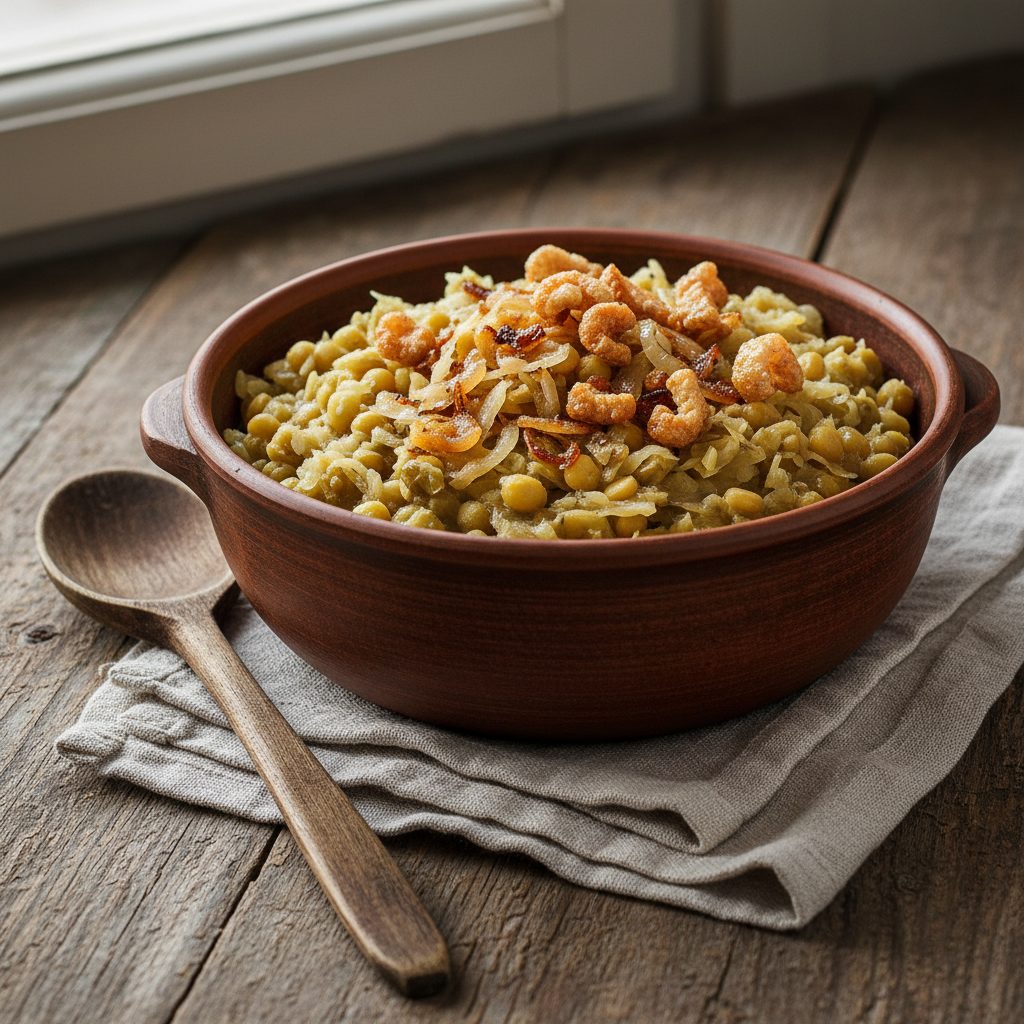
Groch z kapustą, peas with sauerkraut, does not knock. It creeps under the door, squeezes through the ventilation grilles, settles on the net curtains and refuses to leave for a long time. It smells sour, greasy, wintry. It smells of the entrance hall, of a wooden spoon, of steam on the windowpane and of a kitchen where someone was always stirring something, though nobody called it tradition. The pot bubbles low and steady, as if an old village were purring under the lid. A spoon taps the rim. Onion hisses in the lard. The cabbage lets out its heavy breath. And it is clear the house has been occupied.
This is one of those dishes that pulls no faces. It does not flirt from the porcelain. It is thick, sprawling, honestly unlovely. Rustic as a beaten-earth floor, as fairground music and a sheepskin coat smelling of smoke. The peas gave strength for work, the cabbage let you survive the winter, and fat, when there was any, was almost a social promotion. Old suet, salt pork, bacon, cracklings: behold the ancient heraldry of a full belly. Poverty had no gold, so it shone with grease.
In the Lenten version, linseed oil laid a dark, nutty shadow over the dish. In the sinful version, salt pork crunched. And at once applied theology began at the table. Can Christmas Eve bear bacon, can conscience lift a crackling, does the Lord God look into the pot? Some defended the fast, others the flavour, and everyone cited a grandmother who had always done it this way. In Poland the argument from grandmother can be stronger than a statute.
Groch z kapustą tells a good story about us. There is peasant resourcefulness in it, distrust of novelty, attachment to the saints, to the weather and to one's own way of pickling. There is the man from Kuyavia who knows what he knows. The man from Greater Poland with his ciupka. The Silesian who looks at peas in his panczkraut like a foreign army crossing the border. There are recipes guarded like a field boundary and family grudges older than the enamel pot.
Peas were meant to bring prosperity, fertility and a good harvest. Cabbage protected health, because its leaves curled one into another like a roof over a house. On the Christmas Eve table they were to ensure abundance, drive away illness and persuade fate not to be stingy in the coming year. Everyone should eat at least a spoonful. Not only out of appetite. Also out of caution, because you never know which superstition will turn out to be more sensible than people.
Besides, silence does not last long around this dish. Someone says it is too sour. Someone, that the peas are undercooked. Someone remembers their mother. Someone starts on politics, though they promised they wouldn't. The bowl becomes a small parliament where everyone has an amendment to the recipe and nobody intends to yield. In the background cutlery clinks, the stove creaks, children scrape their chairs, and from the kitchen comes a smell so resolute that even the neighbours become involuntary participants in the rite.
It is no accident that groch z kapustą means chaos. This dish knows no geometry. The peas fall apart, the cabbage trails in strands, the fat gleams, the onion clings to everything. There is something in it of a meeting where everyone says their own piece, something of a reform written overnight, and something of a Polish home, where order exists mainly in stories about the old days.
You take a spoon. The taste is sour, floury, heavy, sometimes too salty. Frost outside the window, steam on the panes, a kitchen warm to the point of drowsiness. And for a moment everything smells just as it once did.
It is not about the dish. It is about agreeing that a community need not be elegant. Sometimes it is thick, pungent, stubborn and a little too greasy. Sometimes it sizzles, grumbles and argues about cracklings.
It does not look its best. It keeps people at one table.
## A thousand years in the pantry
Peas and cabbage have been grown on Polish lands for more than a thousand years. Not because anyone particularly loved them, but because they cooperated. They grew easily, yielded abundantly and survived the winter: cabbage in a barrel, pickled, peas dried in a sack. For the peasant and the urban proletariat this was the foundation of the diet, not a matter of taste. A cuisine that has to get through the winter has no time for whims.
The dish was cheap, nourishing and so filling that it sustained hard work in the fields. On ordinary days the poorest ate it undressed, that is dry, without fat. Wealthier farmers, and the poorer ones on feast days, added old suet, bacon, salt pork or cracklings. The omasta, the fat in the pot, said more about a household than many a coat of arms over a gate.
In central Poland groch z kapustą had the status of a festive dish. No wedding could do without it. In time a Lenten version developed too, made with linseed or rapeseed oil, which became a permanent part of the canon of twelve Christmas Eve dishes. So the same bowl served peasant everyday life, wedding revelry and the supper people wait for all year.
## Magic from the field and a calendar of proverbs
In Slavic beliefs peas stood for fertility, wealth and a good harvest, and eating them was supposed to protect people and animals from illness and evil powers. Cabbage was a symbol of vitality and plenty. Its tightly wrapped, overlapping leaves were meant to shield against evil. From the same faith in cabbage's life-giving power came the phrase children still hear when they ask where they came from: we found you in the cabbage. On Christmas Eve the combination of the two was to bring health and a bountiful year.
Peas have 116 proverbs in Polish folklore, cabbage 104. No wonder, since they were the farmer's calendar. "On St Matthias's day they'll sow the cabbage" falls on 24 February. "Mind you, farmers: St Joseph bids you sow peas", that is 19 March. "Who sows peas in March will cook them in a pot." On St Mark's day, 25 April, the pea sprouts from its seed, and by St Roch's, 16 August, it is already in the barn. Cabbage has its own rhythm: on St Lawrence's, 10 August, it forms a wreath, and from St Thaddeus's, 28 October, it gets its hat. People of old had no app with reminders. They had saints.
## A map of disputes
Kuyavia has a documented pedigree. Oskar Kolberg described a traditional Kuyavian dinner of sauerkraut with mashed peas back in the 19th century. In 2012 Kuyavian groch z kapustą was entered on the List of Traditional Products. In the Łódź province, cabbage with peas has been on that list since 2008.
Greater Poland calls it ciupka. The Greater Poland ciupka, even the Christmas Eve one, is often dressed with salt pork, on which a roux of onion and flour is made. In regions that keep a strict fast this would be unthinkable. In Radziwiłłów Mazowiecki they make cabbage with peas so thick that it is shaped into long or oval cutlets and served cold or hot, with cracklings. Where others see chaos, Radziwiłłów sees building material.
The sharpest border runs through Upper Silesia. There the equivalent is panczkraut, also called ciapkapusta or ciapane: mashed potatoes with sauerkraut, generously dressed with bacon and onion. There are no peas in it. Adding peas to cabbage is considered in Silesia a custom of the gorols, people from outside the region, and a culinary profanation. Silesian housewives still wage good-humoured disputes with husbands from other parts of Poland who demand peas in the Christmas Eve cabbage. A mixed marriage there begins with a compromise in the pot, and it does not always succeed.
## Chaos, ventilation and the crackling
The Polish language turned this dish into a diagnosis. Overcooked, floury yellow peas in strands of sauerkraut form a shapeless mass, so "groch z kapustą" means a mess, a random jumble. Politicians and commentators happily use it to describe incoherent laws, chaotic reforms and rows in parliament. A dish that for centuries brought order to the peasant winter became a synonym for organisational failure. An injustice, but there is no arguing with language.
The second dispute is fought through the ventilation shafts. Cooked sauerkraut with peas releases heavy sulphur compounds whose smell does not let go for a long time. In concrete-panel blocks of flats, where ventilation is often shared or leaky, it spreads through the stairwells and into other people's flats. Before Christmas this ends in complaints to the housing cooperative and neighbourly rows about poisoning the air. A community of smells does not always translate into a community of hearts.
The third dispute is theological. Christmas Eve should be meatless, without animal fats, but in many homes, in Greater Poland or Silesia for instance, bacon, lard or salt pork hold on tight. Every year the purists demand the linseed oil version, and the flavour traditionalists reply that without cracklings it isn't Christmas. Both sides invoke grandmother. Both are right, because there were two grandmothers.
## The mandatory spoonful
On Christmas Eve groch z kapustą is served hot, usually as one of the last dishes before makówki or kutia, in a clay or ceramic bowl. Everyone at the table must try at least a spoonful, because refusing foretold illness or poverty in the year ahead. Superstition works better than the hostess's encouragement.
At old weddings in central Poland it was carried in ceremonially late at night, often to the band's music. Hot, fatty and filling, it was supposed to get the tired guests back on their feet and give them the strength to party until dawn. Groch z kapustą was the wedding energy drink before anyone invented the can.
There are also attempts to lend it elegance. In the refined version it is shaped with a cook's ring or, following Radziwiłłów, baked into browned little cutlets sprinkled with caramelised onion and fresh marjoram. You can. But why pretend a community must be pretty, when it is enough that it is warm.
📖 Glossary
- kraszenie
- Dodawanie tłuszczu do potrawy, takiego jak stare sadło, boczek, słonina czy skwarki. U najuboższych groch z kapustą jadano na co dzień bez kraszenia, na sucho.
- ciupka
- Wielkopolska nazwa grochu z kapustą, która nawet w wersji wigilijnej bywa kraszona słoniną z zasmażką z cebuli i mąki.
- panczkraut
- Górnośląski odpowiednik grochu z kapustą, zwany też ciapkapustą albo ciapanym: tłuczone ziemniaki z kiszoną kapustą, boczkiem i cebulą, bez grochu.
- gorol
- Na Śląsku człowiek spoza regionu. Dodawanie grochu do kapusty uchodzi tam za zwyczaj goroli.
- omasta
- Tłuszcz dodawany do potrawy, który w dawnej wsi mówił o zamożności domu więcej niż herb nad bramą.
Frequently Asked Questions
Why is groch z kapustą eaten on Polish Christmas Eve?
For over a thousand years peas and cabbage were the basis of the peasant diet, because they grew easily and survived the winter. In central Poland groch z kapustą was a festive and wedding dish, and its Lenten version, made with linseed or rapeseed oil, joined the canon of twelve Christmas Eve dishes. It was believed to bring health and a plentiful year, so everyone should eat at least a spoonful.
Can groch z kapustą for Christmas Eve have cracklings?
Christmas Eve should be meatless, without animal fats, but in many homes, for example in Greater Poland or Silesia, bacon, lard or pork fat hold firm. Every year purists demand the linseed oil version, and flavour traditionalists reply that without cracklings it is not Christmas. Both sides invoke grandmother.
Why don't Silesians add peas to sauerkraut?
In Upper Silesia the equivalent is panczkraut, also called ciapkapusta or ciapane: mashed potatoes with sauerkraut dressed with bacon and onion. Adding peas is seen there as a habit of the gorols, people from outside the region, and as culinary profanation.
What does the Polish expression groch z kapustą mean?
Overcooked, floury peas in strands of sauerkraut make a formless mass, so groch z kapustą means a mess, a random jumble. Politicians and commentators use it for incoherent laws, chaotic reforms and quarrels in parliament.
What are the regional versions of groch z kapustą?
The Kuyavian version, described by Oskar Kolberg, has been on the List of Traditional Products since 2012, and the Łódź region's cabbage with peas since 2008. Greater Poland's ciupka is often dressed with pork fat and a roux. In Radziwiłłów Mazowiecki the thick mass is shaped into cutlets served with cracklings.
What proverbs are there about sowing peas and cabbage?
Peas have 116 proverbs in Polish folklore and cabbage 104, because they were the farmer's calendar. On St Matthias's day, 24 February, cabbage is sown, and St Joseph, 19 March, bids you sow peas. By St Roch's day, 16 August, the peas are in the barn, and from St Jude Thaddeus, 28 October, the cabbage gets its hat.
Related Questions
- Why is groch z kapustą eaten on Polish Christmas Eve?
- Can groch z kapustą for Christmas Eve have cracklings?
- Why don't Silesians add peas to sauerkraut?
- What does the Polish expression groch z kapustą mean?
- What are the regional versions of groch z kapustą?
- What proverbs are there about sowing peas and cabbage?
🧠 Thematic Groups
- Historia: groch i kapusta od ponad tysiąca lat przetrwały zimę w worku i beczce, karmiąc chłopów i miejski proletariat, a groch z kapustą był obowiązkowy na weselach.
- Wierzenia i przysłowia: groch oznaczał płodność i urodzaj, kapusta ochronę przed złem, a przysłowia o świętych wyznaczały kalendarz siewu i zbiorów.
- Regiony: kujawski groch z kapustą u Kolberga, wielkopolska ciupka, kotlety z Radziwiłłowa Mazowieckiego i śląski panczkraut bez grochu.
- Spory i język: kłótnia o post i skwarki na Wigilii, zapach w blokach z wielkiej płyty i groch z kapustą jako synonim chaosu w polityce.
Tags:
groch z kapustą
sauerkraut
split peas
pork cracklings
linseed oil
Polish cuisine
Christmas Eve
twelve Christmas Eve dishes
Kuyavia
ciupka
panczkraut
Upper Silesia
Radziwiłłów Mazowiecki
Oskar Kolberg
gorol
More in: Kuchnia niepolityczna
Content is created by Fundacja Dobre Państwo.
Edited and published by APA ONE, the Foundation's own AI-based editorial system.